| Home | Letters to the Editor |
| Newspaper Articles | Pictures | How to Help | E-Mail Us |
Project Restore: Historic All Saints
Construction Update - June 2008
- Construction Update
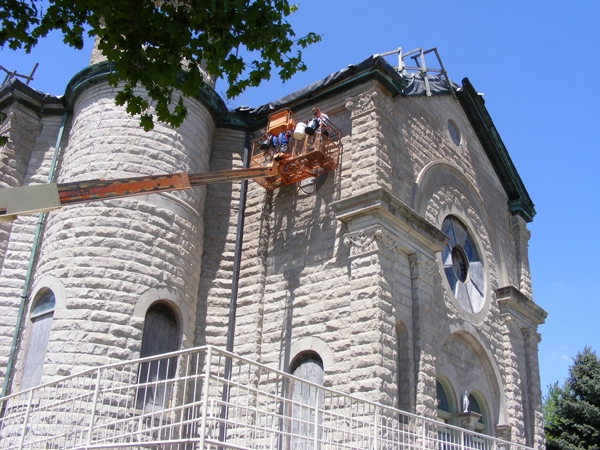
- Construction on Historic All Saints began in March 2008, but the architects and contractors have been working since November 2007. The architects, HLKB in Des Moines, are working on the detailed construction documents and they, the contractor (Koester Construction in Grimes) and Project Restore meet weekly to coordinate plans, work and options.
- Inside Flooring
- The first challenge faced was the concrete slab from the original construction. Last winter had been extremely hard on it and the moist spring made the dirt under it very soggy. These combined factors made bringing a lift inside impossible so we dug out the concrete and underlying dirt and put in new layers of stone and river rock which we will pour concrete over later. Marty Forcht’s company was subcontracted to do the dirt and gravel work. As we have said all along, we will use qualified local contractors as much as possible.
- Outside Limestone Tuckpointing
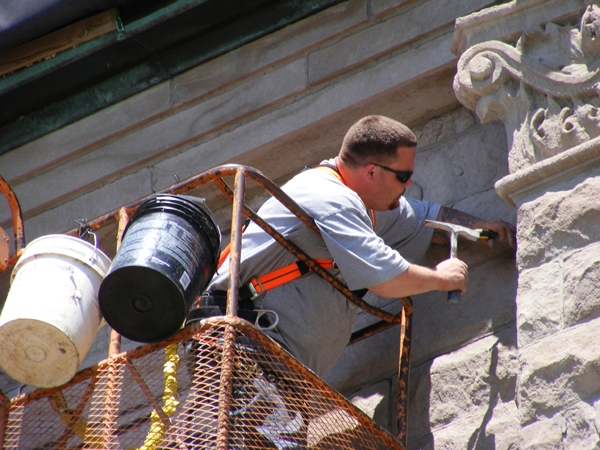
- While Marty was working on the floor inside, highly skilled stone and brick artisans, Mike Caligiuri and crew, worked on tuckpointing the exterior limestone from top to bottom all around the building. He was impressed with how well the limestone has held up and weathered. The wall protection system that John Slayton developed years ago was a factor in keeping the limestone in good condition. Now that the inside has a sturdy layer of gravel and stone, Caligiuri can move his lift inside in order to begin tuckpointing on the thousands of inside bricks which will remain exposed in the final interior. Before the inside tuckpointing, a demo team will come in and remove the remaining wood framing that was not removed during earlier debris and safety clean ups.
- Structural Engineering
- The structural engineer, Jim Tometich, has been at the site numerous times, testing soil, foundation and more. He reports that the soil is in good condition and was happily surprised when he dug deep into the foundation to find a step foundation (concrete) rather than brick. Historic All Saints was cutting edge at the time it was built. Tometich says that that the structure of the building was so “overbuilt” that he is confident that the existing footings, foundation and steel will hold the new roof and dome. However, detailed testing of the steel and upper walls will be done now that it is possible to bring a lift inside to get samples from all around the building.
- Windows, Roof, Dome and Elevator
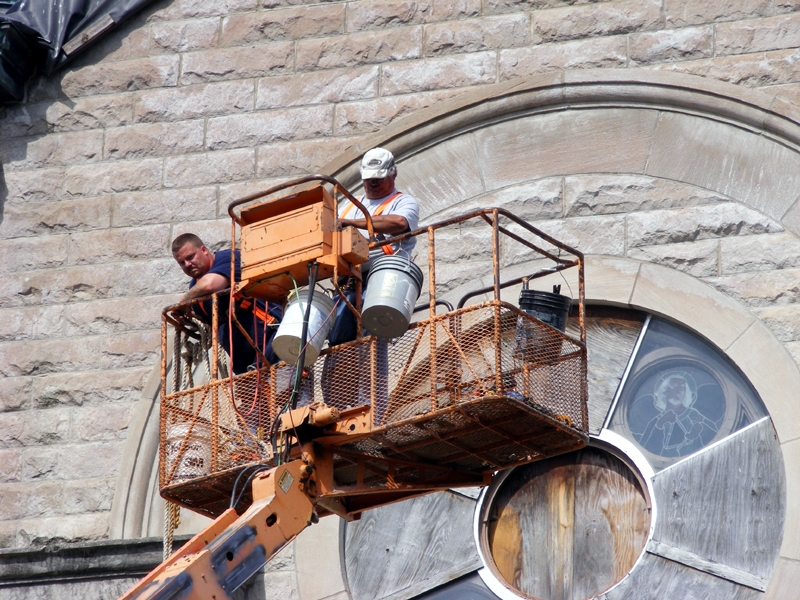
- The plan is to remove the damaged stained glass windows for safe storage until funds are available for restoration and to restore the windows that are in tact, leaving them in place. Clear glass will replace the damaged stained glass windows. The roof will be designed and built in order to safely hold clay tiles, though the current budget will not allow for the expense of real tile – an historically-correct alternative that provides the same aesthetics as the red tile will be used in the mean time.
The roof will be on the building before winter including the dome which will be assembled on the ground and lifted into place this fall. Yet to be determined is how much copper we will be able to use and whether we can afford copper on the dome or in lieu of copper, a metal treated to look like patina copper. Also yet to be determined is whether we can afford an elevator so as to allow us to remove the ramp that obstructs the front of the building. An elevator is estimated to be approximately $90,000. We will however pour the footings and create the necessary infrastructure during construction to allow for incorporating an elevator later if we can not afford it now.
Back to Top
| Home | Letters to the Editor | Newspaper Articles | Pictures | How to Help | E-Mail Us |
©1996-2008 Project Restore, Stuart, IA USA. All Rights Reserved.
Web site designed and hosted by QTH.com